
The giant of Aden has finally risen from his sleep.. The Aden National Project and the right of Aden to write its future
Aden was never an ordinary city, it was always larger than its geographical borders and wider than any recognized political definition, a city that ma
The giant of Aden has finally risen from his sleep.. The Aden National Project and the right of Aden to write its future
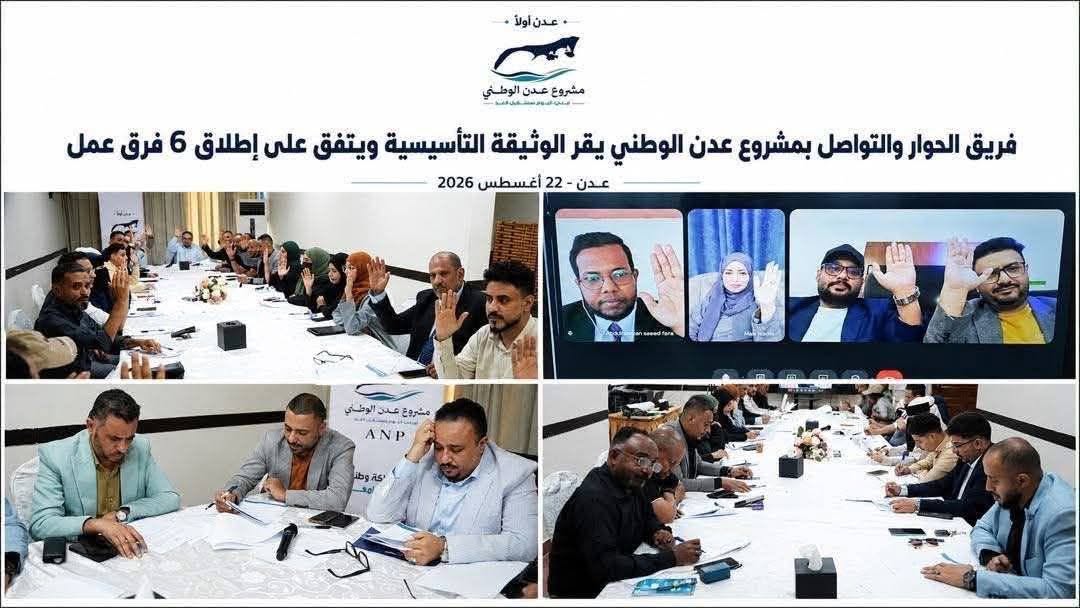
Aden was never an ordinary city, it was always larger than its geographical borders and wider than any recognized political definition, a city that made a place for itself in history from its location, openness and diversity of its people, and from its ability to bring together different people under one roof without asking them to be similar. Therefore, talking about Aden today cannot be about a city that is looking for a service, a road, or a project only. The issue is much deeper. We are talking about a city that has been exhausted by conflicts and divisions, and has gradually distanced its people from their natural right to participate, make decisions, and determine what they want their city to be. Since the independence of Aden in 1967 until today, the city has had many stages, and the authorities, projects and slogans have changed, but the question remained, what does Aden want for itself?Who has the right to answer this question? I think that the answer can no longer be postponed. Aden today needs to speak for itself, not for others to speak for it, nor to turn into an arena on which political projects wrestle, while its society remains at the end of each stage in front of the same questions about services, the economy, identity, status and the future. Hence the idea that we believed in from the first moment, when we started working together on the Aden National Project. We were not looking for a new name to be added to the scene, nor for a platform that competes with anyone, nor for a new political position. We were looking for something simpler and deeper, for a space in which Adeni can say what he wants, for a space in which different people sit around one table without being a reason for exclusion, for a space that does not ask man where he came from before asking him what he can offer to Aden, and for a framework that restores consideration to the idea that the city does not belong to a party, a component, or a directorate. Neither for a person, nor for a financier, Aden belongs to all its children, and this is the essence of the Aden National Project. The project is not a political party, does not seek power, and does not want to replace the state or institutions. It is an independent civil-political platform for dialogue and the production of visions and public policies on Aden. This is not a definitive formulation, but a clear position on the whole scene. We want to move from talking about it to talking with it, and from being the subject of decisions until its society becomes a partner in decision-making, and from scattered demands to clear priorities. The response was to translate into a viable vision, shifting from a struggle for representation in Aden to action for Aden. Therefore, our aim was not to create yet another component to add to the existing list; our goal was to create a historical Aden document that would serve as a comprehensive Adeni reference point, encompassing all political approaches agreed upon by all Adenis, and to begin with the people. To listen. To gather knowledge. To know where the city actually stands, what it needs, what can work, what has failed and why, and then turn all of this into policies that can be discussed, implemented and followed up. This is the idea that underpins our path from voice to policy, from listening to data, from data to the policy lab, and then to practical papers that reach stakeholders and are subject to follow-up and accountability. We do not want Aden, a city that is looking every year for a new beginning, we want it a city that knows where to go, a safe and stable city, a city with efficient and transparent institutions, a city where the economy is present along with politics, services along with slogans, and the human being next to every project, a city that protects its memory, heritage and civil identity, and opens its doors to the future, and this is not a romantic dream, this is Aden that we believe is able to be again. Aden does not need more division. Aden needs a space where differences can be accommodated and not turn into hostility. It needs equal citizenship where a person is not asked about their origin, dialect, lineage, or sect in order to obtain their rights in the city. It needs to recognize that its diversity is not a problem to be eliminated, but rather one of its most important strengths. These are not slogans that we have chosen now, they are the governing principles that we have set since the establishment of the project that the rule of law is above all and dialogue is the basis for consensus, pluralism and diversity, non-exclusion and discrimination, decision-making independence, transparency and accountability, public interest, efficiency, community participation, sustainable development, heritage and identity protection and institutional work. Therefore, the Aden National Project does not tell the Adenis that we know your future, but rather tells them to come and make it together. We do not say that we have the truth alone, but we say that the truth starts from listening, and we do not say that we represent Aden alone, but we say that Aden is too big for anyone to monopolize its representation, and we do not say that politics alone can save the city. We say that politics, when separated from society, knowledge and law, turns into a struggle for power, while politics that Starting from the needs of people can turn into a way to build the state and the city together, so we chose to have our project open to everyone who made Aden the home of his life and future, without geographical origin, descent, dialect or sect being a criterion for belonging. I do not write this as a bystander to the idea. I am one of those who carried it from its inception. We started this project knowing that the road will not be easy. We know that talking about Aden in a different way will put us in front of many questions, and perhaps more objections, but we believe that a city that deserves to regain its position cannot be built by fear of questions, hesitation in front of difference, or reproducing the past in the same way. We want to open a new door, a door that does not cancel the past and does not deny what Aden has lived, but it refuses to keep its future captive. We want to reach a moment when Adeni can see in front of him a city in which he not only lives, but participates in determining its direction. A city restoring its economy; protecting its heritage. Improved her services; empowered her youth. It opens the door to its women and its competencies; it recovers its institutions. Above all, she restores her parents' confidence that their voice can make a real difference in the equation. Some may disagree with us, and this is their right, and the visions of the Adenites may differ about the shape of the future and this is normal, but what is no longer normal is that the difference remains a reason to disrupt the city. Aden does not need to agree on everything, it needs to agree that it deserves to have a future, and this is the agreement we are looking for, not a political agreement at the expense of anyone, nor an alignment against anyone, as much as it is a civil agreement that the interest of Aden must be the starting point. For dialogue to be our way. The law is our reference. Truth is our guide. Knowledge is our tool. Participation is our tool. The future is our goal. We do not promise people illusion or idealism, we promise them something more realistic, to work together for a better Aden, and here lies the value of the Aden National Project. For the love of the city to shift from feeling to action, belonging to it from identity to responsibility, complaining from case to case, the issue from demand to policy, politics from paper to decision, and the decision from promise to reality. This is the Eden we want, and this is the Eden that its future generations deserve. Aden, which does not have an individual, a party, a directorate or a financier the right to monopolize its voice, Aden, where difference is richness, diversity is strength, dialogue is a road, and participation is really, Aden, which regains its special status, privacy and status not because it has returned to the past, but because it has made for itself a future worthy of its history, and from here we began, and from here we will continue. Aden first.. Through dialogue we create the vision.. and with participation we build the future. Article by : Mohammed Anwar Al-Adni